


Leaving a job often comes with a long to-do list, and deciding what to do with your old 401(k) may not be at the top of it. But if you've built meaningful retirement savings in your former employer's plan, it's worth giving that account some attention rather than automatically moving it or forgetting about it.
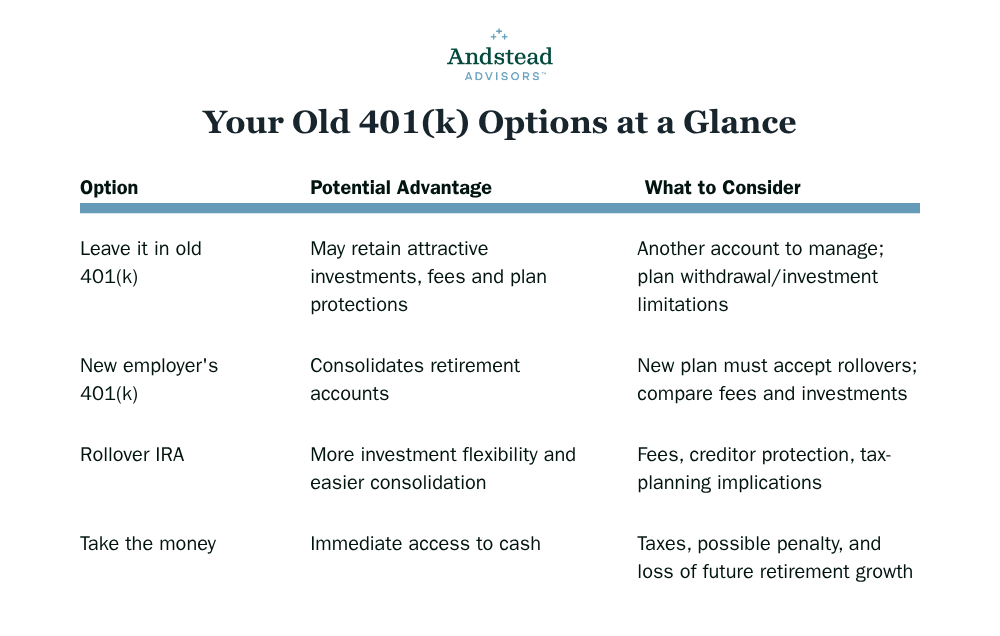
In most cases, you have four options for an old 401(k): leave it with your former employer, roll it into your new employer's retirement plan, roll it into an IRA, or take a distribution. Each option has advantages and tradeoffs, and the best choice depends on the plans available to you, fees, investment options, taxes, and your broader retirement strategy.
Option 1: Leave Your 401(k) With Your Former Employer
You don't necessarily have to move your 401(k) when you leave a job. Many employers allow former employees to keep their retirement savings in the plan, although the rules can vary and smaller balances may be handled differently.
Leaving the account where it is can make sense if the plan offers competitive fees and investment options you like. Employer-sponsored plans also generally receive broad federal creditor protection, and some offer institutionally priced investments that may be difficult to replicate elsewhere. The downside is having another account to monitor, along with the possibility of more limited investment or withdrawal options.
There can also be an important benefit for someone leaving a job later in their career. If you separate from that employer during or after the year you turn 55, distributions from that employer's 401(k) may qualify for an exception to the usual 10% early-withdrawal penalty. Rolling the account into an IRA can mean giving up that particular exception, so access to the money should be considered before initiating a rollover.
Option 2: Roll Your Old 401(k) Into Your New Employer's Plan
If your new employer's 401(k) accepts rollovers, consolidating your old account into the new plan can simplify your retirement savings. Instead of managing multiple workplace accounts, you can keep more of your retirement assets together while maintaining the protections and features associated with an employer-sponsored plan.
Before making the move, compare the two plans. Look at investment choices, fund expenses, administrative fees, withdrawal provisions, and other plan features rather than assuming the new plan is automatically better. Depending on your age and employment situation, keeping assets in a current employer's plan can also have implications for required minimum distributions.
Option 3: Roll Your Old 401(k) Into an IRA
Rolling an old 401(k) into an IRA is another common option. An IRA may offer a broader range of investments than an employer-sponsored plan and can make it easier to consolidate retirement accounts from several previous jobs into one place.
More flexibility doesn't automatically make an IRA the better choice. Investment and advisory fees may differ, federal creditor protections aren't identical to those available in a 401(k), and moving pretax assets into an IRA can affect certain tax strategies, including the tax treatment of future backdoor Roth IRA contributions.
If your old 401(k) includes highly appreciated employer stock, there may also be special tax considerations involving net unrealized appreciation, or NUA. That's a more specialized strategy, but it's a good example of why you should understand what you own before rolling an entire 401(k) into an IRA.
Option 4: Take the Money as a Distribution
You can also withdraw the money from your old 401(k), but doing so can have significant tax consequences. Pretax distributions are generally subject to ordinary income tax, and if you're under age 59½, a 10% additional tax may also apply unless you qualify for an exception.
The bigger cost may be what happens to your long-term retirement savings. Money removed from the account no longer has the opportunity to remain invested on a tax-deferred basis, so a relatively small distribution today can have a much larger impact over time.
What Should You Consider Before Rolling Over an Old 401(k)?
A rollover can simplify your finances, but consolidation alone shouldn't drive the decision. Start by comparing what you already have with what you're considering moving into.
Review the fees and expenses of both accounts, available investments, withdrawal options, and whether you expect to need access to the money before retirement. You should also consider whether you own company stock in the plan, whether creditor protection is important to you, and whether an IRA could affect other tax-planning strategies.
If you're considering moving the account into a new employer's 401(k), first confirm that the plan accepts incoming rollovers. Then evaluate whether consolidating actually gives you a better retirement account rather than simply fewer accounts.
If You Decide to Roll Over Your 401(k), How You Move It Matters
If you decide a rollover is appropriate, a direct rollover is generally the cleanest way to move the account. With a direct rollover, the retirement assets move from one plan or financial institution to another without the money being paid directly to you.
If a distribution from the plan is instead made payable to you, mandatory federal income tax withholding can apply, and completing a rollover becomes more complicated. There is generally a 60-day deadline to complete an eligible rollover, which creates another opportunity for unintended taxes or penalties if the process isn't handled correctly.
Don't Roll Over Your 401(k) Just Because You Left the Job
Changing jobs creates a decision about your 401(k), but it doesn't automatically create a reason to move it. Sometimes leaving the account in a strong former employer plan is perfectly reasonable. In other situations, consolidating into a new 401(k) or IRA can make your retirement savings easier to manage and better aligned with your overall investment strategy.
Before moving an old 401(k), consider what you're gaining and what you may be giving up. Fees, investments, taxes, withdrawal rules, account protections, and convenience can all affect the decision.
The goal isn't simply to get rid of an old account. It's to put your retirement savings in the place that best supports your overall financial plan.

Frequently Asked Questions
Q: What should I do with an old 401(k) after leaving a job?
A: In most cases, you have four options: leave your 401(k) with your former employer, roll it into your new employer’s plan if permitted, roll it into an IRA, or take a distribution. The best option depends on fees, investments, taxes, withdrawal rules, and your overall retirement strategy.
Q: Should I roll over my old 401(k) to an IRA?
A: A 401(k) rollover to an IRA may provide more investment choices and make it easier to consolidate retirement accounts, but it isn’t automatically the best choice. Compare fees, investment options, creditor protections, withdrawal rules, and potential tax-planning implications before making a rollover decision.
Q: Can I leave my 401(k) with my old employer?
A: Often, yes, although plan rules and account balance requirements can vary. Leaving an old 401(k) in place may make sense if the plan offers competitive fees, attractive investment options, or other features you want to preserve.
Q: Can I roll an old 401(k) into my new employer’s 401(k)?
A: You may be able to if your new employer’s plan accepts incoming rollovers. This can simplify your retirement accounts, but you should compare the fees, investments, and features of both plans before deciding to consolidate.
Q: Do I pay taxes when I roll over a 401(k)?
A: A properly completed direct rollover of pretax 401(k) assets to another eligible pretax retirement account generally does not create current taxable income. Different tax consequences can apply if you take the money personally, convert pretax assets to Roth, or don't complete an eligible rollover correctly.
Q: Is it a good idea to cash out an old 401(k)?
A: Cashing out an old 401(k) can result in income taxes and potentially an additional 10% tax if you are under age 59½ and no exception applies. It also removes money from your retirement savings, eliminating the opportunity for those assets to remain invested on a tax-deferred basis.
Q: What is the Rule of 55 for a 401(k)?
A: The Rule of 55 generally allows qualifying distributions from the 401(k) of an employer you separate from during or after the calendar year you turn 55 without the usual 10% early-distribution additional tax. Rolling those assets to an IRA can mean losing access to that specific exception.
About Andstead Advisors
Andstead Advisors is an independent financial planning and wealth management firm headquartered in Denver's Denver Tech Center, serving individuals, families, retirees, and business owners throughout Colorado and across the country. Our team provides comprehensive financial planning, investment management, retirement planning, business owner solutions, retirement plan consulting, business succession planning, cash balance plan strategies, profit sharing plans, and Solo 401(k) guidance. As fiduciary advisors, we help clients make informed financial decisions through personalized advice, long-term planning, and ongoing partnership designed to support their financial goals at every stage of life.