
Five for Friday - July 19, 2024
7/19/2024
Inflation, Rotation, Expectations, Fall Gyration, and Exploration
1. Disinflation
Last week, June inflation data came in lower than expected and sparked a major rally in short-term bonds (i.e., yields fell). Headline CPI now sits at 3.0% year over year, its lowest since March 2021, while CPI ex-housing registered just 1.8% year over year (its 14th consecutive month below 3.0%). The data builds on a softer May CPI report, giving the Fed more than just one data point to start making the case for lowering interest rates this year. As of writing, markets are pricing in a 98% probability of a rate cut at the Fed’s September meeting, and a more than 50% chance of at least 3 rate cuts by year-end (up from 7% in May). These odds could swing if the data changes, but market predictions have historically borne out come Fed meeting time. Inflation is unlikely to continue lower in a straight line, but barring something unforeseen, the long-awaited first cut will hit in September and end the second longest Fed “pause” in 50 years.
2. Small
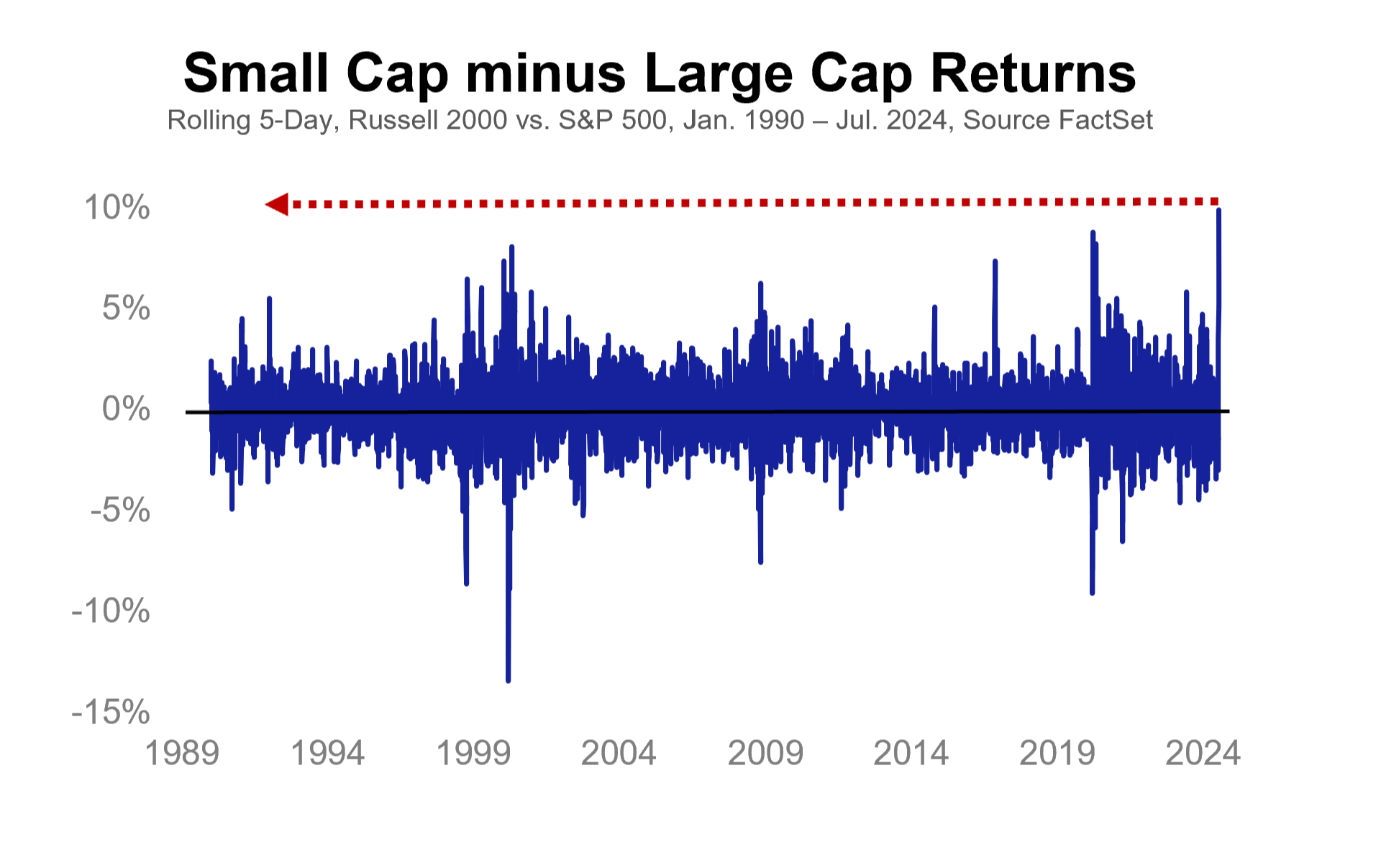
The inflation data didn’t just send bond yields lower, however. It also sparked a massive rotation in stocks, with investors shedding the Big Tech / AI trade that had worked so well in favor of cyclical sectors and beaten-down Small Caps. In fact, for the five days ending July 16, the Small Cap Russell 2000 outperformed the S&P 500 by roughly 10%, the largest gap since at least 1990. The rally is spurred in part by the lower rates themselves – Small Caps have less cash and more floating rate debt than their larger counterparts, meaning a dip in rates has an outsized impact on their profitability and ability to thrive. I’m more skeptical of Small Cap’s longer-term case given the odds that interest rates remain higher for longer, but the momentum is clearly with them for now – and the market narrowness that had investors on edge is subsiding rapidly.
3. Expecting
For many reasons (here, here), the Federal Reserve cares about inflation expectations as an influence on actual inflation. This is why a recent spike in long-run inflation expectations as measured by the University of Michigan Survey of Consumers might raise a red flag. But to get at the heart of the spike, we have to peel back the onion a bit. First, while the mean expectation is spiking, the median has stayed flat, meaning a small handful of survey participants are pulling up the average with estimates for 15%+ hyperinflation. Even more interestingly, UMich notes that these predictions have become a lot more common in recent months since they switched from phone to web interviews – the idea being that people are far more likely to espouse maximalist views online than in voice. All in, they conclude that, “the recent increase in mean inflation expectations is unlikely to reflect a substantive shift in consumer attitudes.” A fascinating result that says as much about the reliability of survey data (quite murky) as it does about how the internet impacts discourse.
4. Fall
Since 1945, August and September are two of three months where the S&P 500 averages a negative return. The market’s recent calm (we’re currently in the longest streak without a 2% single-day drop in the S&P 500 since the mid-2000s) might be enough to raise expectations for future volatility on its own (calm plants the seeds of crazy), but a difficult seasonal backdrop further ups the ante. With that being said, seasonality is not everything – just in the last 15 years, there has been an August with a 7% return and a September with a 9% return. It’s never a bad time to mentally prepare oneself for a more volatile ride in the stock market, but relying on seasonality alone as a timing tool could easily lead one astray.
5. On this day
55 years ago, Apollo 11 was en route to becoming the first spaceflight to land humans on the Moon. It was a landmark moment for a number of reasons, but one that stands out in the context of today’s AI discourse is the major innovation in computing it drove. In a BBC retrospective, author and MIT professor David Mindell noted that "Apollo was the moment that people stopped talking about how big their computers were and started bragging about how small they were.” The success of the mission and focus on computing miniaturization helped pave the way to where we are today.
Disclosures
The information offered is provided to you for informational purposes only. Robert W. Baird & Co. Incorporated is not a legal or tax services provider and you are strongly encouraged to seek the advice of the appropriate professional advisors before taking any action. The information reflected on this page are Baird expert opinions today and are subject to change. The information provided here has not taken into consideration the investment goals or needs of any specific investor and investors should not make any investment decisions based solely on this information. Past performance is not a guarantee of future results. All investments have some level of risk, and investors have different time horizons, goals and risk tolerances, so speak to your Baird Financial Advisor before taking action.
This is not a complete analysis of every material fact regarding any company, industry or security. The opinions expressed here reflect our judgment at this date and are subject to change. Market and economic statistics, unless otherwise cited, are based on data from FactSet. The information has been obtained from sources we consider to be reliable, but we cannot guarantee the accuracy.
This report does not provide recipients with information or advice that is sufficient on which to base an investment decision. This report does not take into account the specific investment objectives, financial situation, or need of any particular client and may not be suitable for all types of investors. Recipients should not consider the contents of this report as a single factor in making an investment decision. Additional fundamental and other analyses would be required to make an investment decision about any individual security identified in this report.
For investment advice specific to your situation, or for additional information, please contact your Baird Financial Advisor and/or your tax or legal advisor.
Fixed income yield and equity multiples do not correlate and while they can be used as a general comparison, the investments carry material differences in how they are structured and how they are valued. Both carry unique risks that the other may not.
Past performance is not indicative of future results and diversification does not ensure a profit or protect against loss. All investments carry some level of risk, including loss of principal. An investment cannot be made directly in an index.
Copyright 2024 Robert W. Baird & Co. Incorporated.
Other Disclosures
UK disclosure requirements for the purpose of distributing this research into the UK and other countries for which Robert W. Baird Limited holds an ISD passport.
This report is for distribution into the United Kingdom only to persons who fall within Article 19 or Article 49(2) of the Financial Services and Markets Act 2000 (financial promotion) order 2001 being persons who are investment professionals and may not be distributed to private clients. Issued in the United Kingdom by Robert W. Baird Limited, which has an office at Finsbury Circus House, 15 Finsbury Circus, London EC2M 7EB, and is a company authorized and regulated by the Financial Conduct Authority. For the purposes of the Financial Conduct Authority requirements, this investment research report is classified as objective.
Robert W. Baird Limited ("RWBL") is exempt from the requirement to hold an Australian financial services license. RWBL is regulated by the Financial Conduct Authority ("FCA") under UK laws and those laws may differ from Australian laws. This document has been prepared in accordance with FCA requirements and not Australian laws.


