
Five for Friday - August 16, 2024
8/16/2024
Rates, Recession, Housing, Volatility, and Telegraphy
1. Rates
While there’s been plenty of debate over how aggressively and how quickly the Fed needs to lower interest rates, one thing seems settled: they will be cutting rates in September. As of this writing, markets are pricing 100% odds of at least one rate cut at the Fed’s next meeting. So, what then? The range of equity returns from a cycle’s first rate cut is wide and highly dependent on the economic environment. In 2001 and 2007, the first rate cut immediately preceded a recession, and the S&P 500 fell by 14% and 21% over the next year, respectively. In 1984 and 1995, however, the opposite happened. The economy avoided immediate recession and the S&P 500 rose by 13% and 19% over the following year (in 2019, the economy and market were following a similar path until the Covid-19 pandemic turned the entire cycle upside down). All to say, monitoring for recession becomes even more critical once the Fed starts cutting. We’re on the doorstep now.
2. Recession
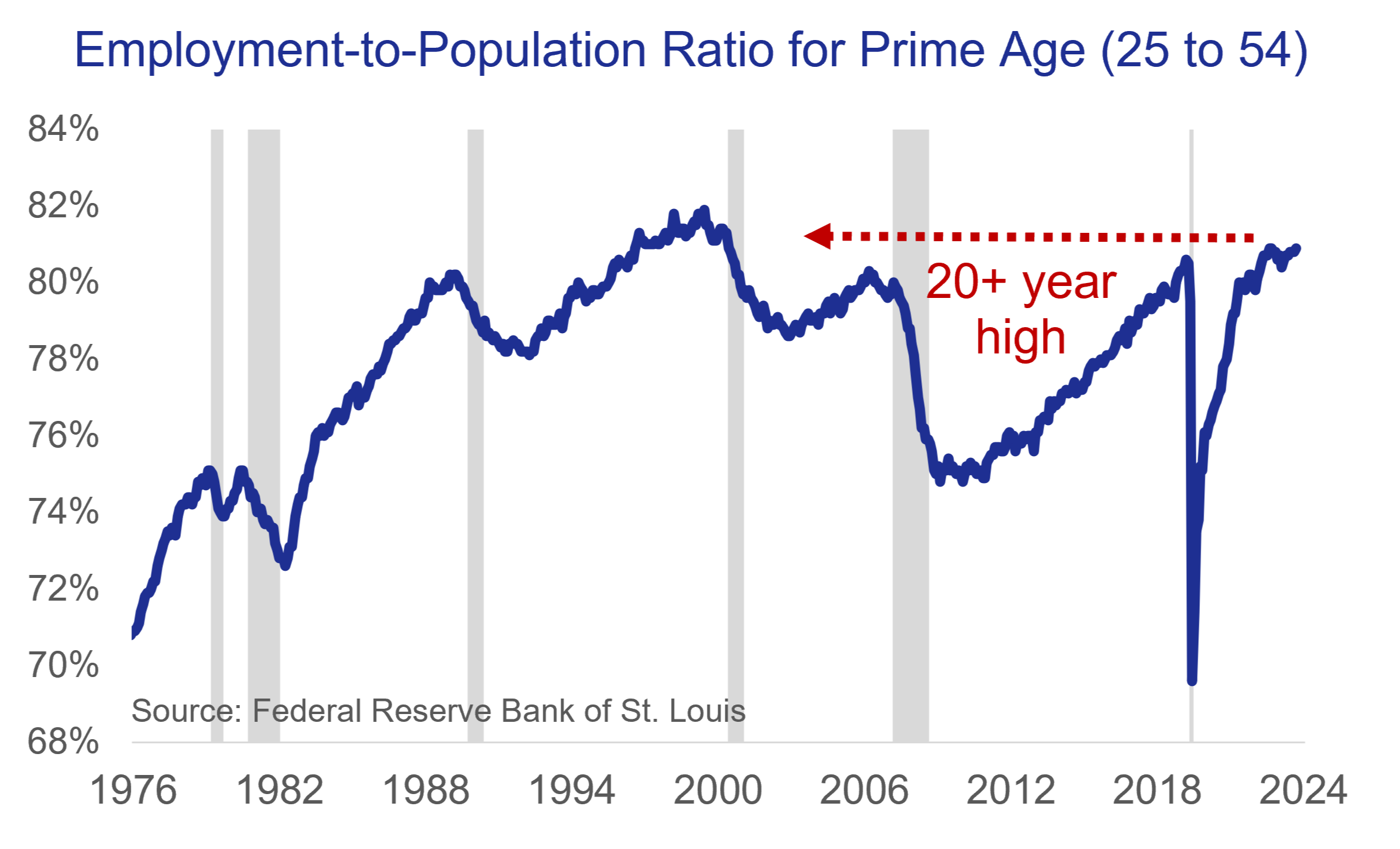
So, is a recession imminent? Despite the rising unemployment rate causing angst, one reason that a near-term recession still seems unlikely is that it is rising in part because the size of the labor force is growing…not because layoffs have materially ticked up (you have to be “in the labor force,” i.e., looking for work, to be “unemployed”). The prime age employment-to-population ratio remains at cycle highs and is only a hair lower than its late 90s all-time high. But that balance is precarious, and a shift higher in layoffs would be a serious red flag. To that end, the initial claims for unemployment insurance numbers might be the most closely watched – and market-moving – data in the world over the next few months. Last week, the market rallied to its best day since 2022 when claims came in better than feared. It is a high quality, high frequency (weekly) data set and will be appointment TV in the coming weeks.
3. Housing
In last week's Market Strategy video, Strategas Chief Economist Don Rissmiller discussed the anticipation of lower interest rates and where he would like to see more activity as rates drop. To him, housing is an obvious candidate. It is a historically rate-sensitive sector that has seen recessionary levels of activity in recent months as higher interest rates have stifled building, buying, and selling (with existing homeowners "locked in"). But things are changing. Per Redfin, mortgage rates hit their lowest level since April 2023 last week (unlocking ~$30,000 in buying power over the last month alone) at the same time as prices are wobbling. Housing is still historically expensive, but inventory is on the rise and the share of home listings with a price drop is at its highest level in years. Rates have come down materially in recent weeks, but if that can’t stimulate activity in rate-sensitive sectors, the question will be whether the Fed did too little, too late.
4. Volatility
Amid all the chaos of last week (including the market’s worst day in nearly two years), the actual week itself was shockingly flat. In the end, the S&P 500 lost just 0.04%, the mildest down-week since 2018 and one of the ten smallest weekly dips in 25 years. This dichotomy – a mild, flat week composed of five individual, volatile days – is a common one in markets; an investment’s end performance says very little about the path it took to get there (and could perhaps even obscure something important). The S&P 500 is up over 230% in the last 10 years, but that result comes in spite of recessions, bear markets, and countless uncertainties along the way. Only looking to the end result – whether over a week or a decade – ultimately undermines what it takes to be a great investor: resolve, steadfastness, and a long-term vision.
5. On this day
in 1858, the first official transatlantic telegram was sent: a congratulations note from Queen Victoria to U.S. President Buchanan. I was going to write about the economic impact of the invention, but instead got lost down a Wikipedia rabbit hole of innovation after innovation that led us from then to today: a world of near-instantaneous, globally-reaching, high-definition video chatting. Human innovation and ingenuity is something worth marveling at – and investing in.
Disclosures
The information offered is provided to you for informational purposes only. Robert W. Baird & Co. Incorporated is not a legal or tax services provider and you are strongly encouraged to seek the advice of the appropriate professional advisors before taking any action. The information reflected on this page are Baird expert opinions today and are subject to change. The information provided here has not taken into consideration the investment goals or needs of any specific investor and investors should not make any investment decisions based solely on this information. Past performance is not a guarantee of future results. All investments have some level of risk, and investors have different time horizons, goals and risk tolerances, so speak to your Baird Financial Advisor before taking action.
This is not a complete analysis of every material fact regarding any company, industry or security. The opinions expressed here reflect our judgment at this date and are subject to change. Market and economic statistics, unless otherwise cited, are based on data from FactSet. The information has been obtained from sources we consider to be reliable, but we cannot guarantee the accuracy.
This report does not provide recipients with information or advice that is sufficient on which to base an investment decision. This report does not take into account the specific investment objectives, financial situation, or need of any particular client and may not be suitable for all types of investors. Recipients should not consider the contents of this report as a single factor in making an investment decision. Additional fundamental and other analyses would be required to make an investment decision about any individual security identified in this report.
For investment advice specific to your situation, or for additional information, please contact your Baird Financial Advisor and/or your tax or legal advisor.
Past performance is not indicative of future results and diversification does not ensure a profit or protect against loss. All investments carry some level of risk, including loss of principal. An investment cannot be made directly in an index.
Copyright 2024 Robert W. Baird & Co. Incorporated.
Other Disclosures
UK disclosure requirements for the purpose of distributing this research into the UK and other countries for which Robert W. Baird Limited holds an ISD passport.
This report is for distribution into the United Kingdom only to persons who fall within Article 19 or Article 49(2) of the Financial Services and Markets Act 2000 (financial promotion) order 2001 being persons who are investment professionals and may not be distributed to private clients. Issued in the United Kingdom by Robert W. Baird Limited, which has an office at Finsbury Circus House, 15 Finsbury Circus, London EC2M 7EB, and is a company authorized and regulated by the Financial Conduct Authority. For the purposes of the Financial Conduct Authority requirements, this investment research report is classified as objective.
Robert W. Baird Limited ("RWBL") is exempt from the requirement to hold an Australian financial services license. RWBL is regulated by the Financial Conduct Authority ("FCA") under UK laws and those laws may differ from Australian laws. This document has been prepared in accordance with FCA requirements and not Australian laws.


