
Five for Friday - April 11, 2025
Crashes, Volatility, Trade War, Risk Tolerance, Uncertainty
1. Sharp selloffs
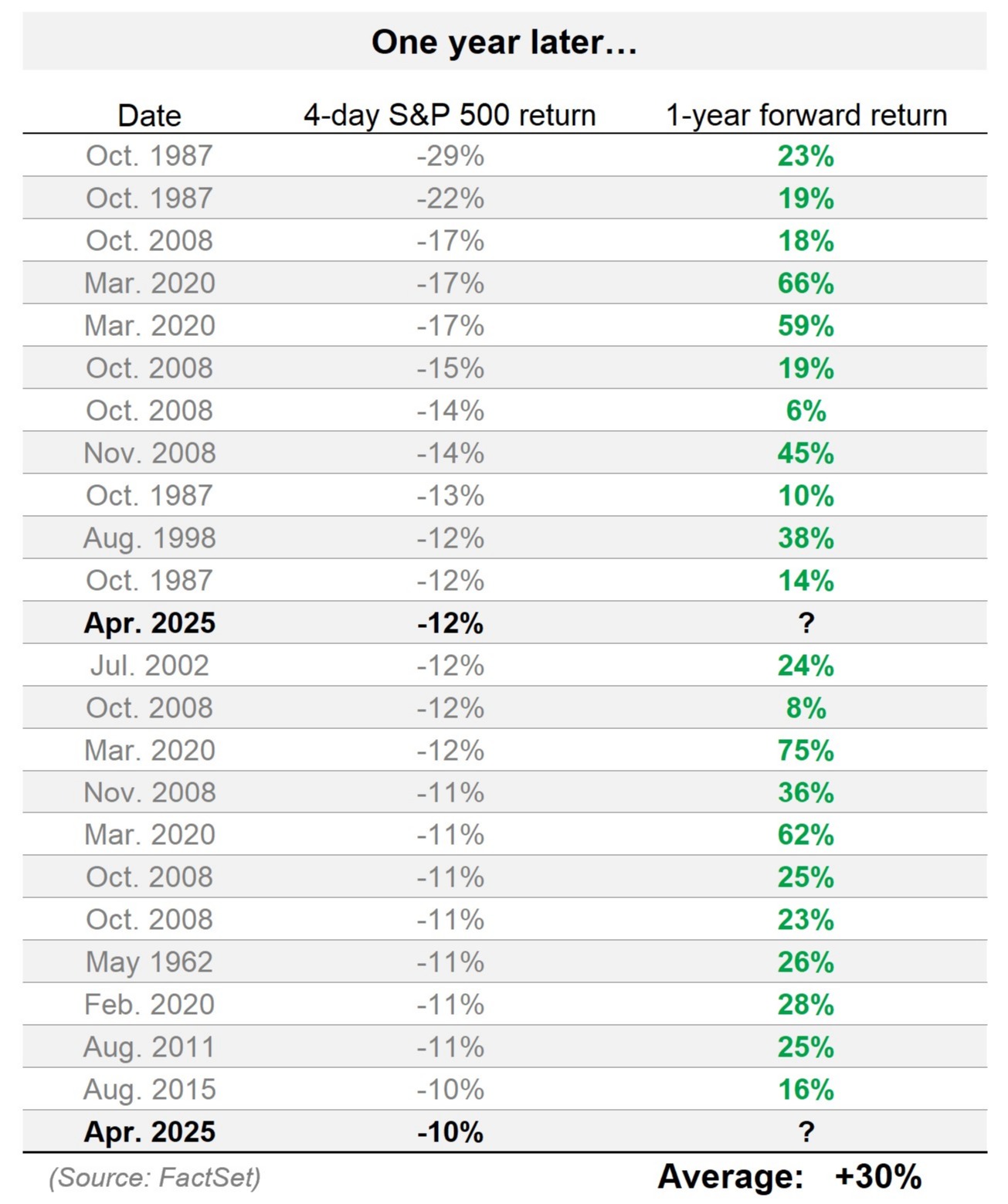
The S&P 500 fell 12% over the four days ending Apr. 8, one of the worst stretches since WWII. Below, we list every instance where the S&P 500 fell 10% or more in four days since then, and how the market performed over the 12 months that followed. Sharp crashes + historic bearishness + marketwide defensiveness = a lot of bad news being priced into the market at once. We can’t know what happens this time, but in the past the outcome has often been quite different than the market’s first/worst impulse.
2. Volatility
With the above said (and having noted a quick bounce on a tariff reversal was possible), markets are not in the clear after Wednesday’s announced pause for “reciprocal” tariffs. The tariffs left in place are still at one of the highest levels in a century, and the uncertainty sowed by the recent actions could still weigh on businesses’ willingness to invest and hire. The 90-day “pause” clock starts ticking now, and in the meantime, there is a massive tax bill to pass and a debt ceiling to raise. I’d also expect that many of the companies that report earnings over the next few weeks will temporarily rescind their guidance due to the uncertainty, which will widen the range of likely outcomes down the line. Investors can celebrate Wednesday’s huge rally and still be clear-eyed about the possibility that volatility persists into the summer.
3. China
Some concern is bubbling that one of China’s options in a trade war would be to dump their U.S. Treasuries to spike borrowing costs. I’ll write more about this in the future, but one thing I rarely see mentioned is that the Federal Reserve has previously purchased Treasuries (en masse) to stabilize financial markets. The Fed’s balance sheet grew by $400 billion in just two weeks during the 2023 regional banking crisis. If China sold their $740 billion in Treasuries all at once (deeply unlikely given the pain it would also cause China), why wouldn’t the Fed just act as the “buyer of last resort” to stabilize U.S. markets?
4. Risk
The great financial writer Jason Zweig once joked: “If I ask you in a questionnaire whether you’re afraid of snakes, you might say no. If I throw a live snake in your lap and then ask if you’re afraid of snakes, you’ll probably say yes—if you ever talk to me again.” It’s simple enough to be risk-on during a bull market (and even to say you’d buy more on a selloff) but facing the reality of a crash turns that intellectual answer into an emotional reality. Risk tolerance is something that can only be truly calibrated when the chips are down. Now is as good a time as ever to sit with your Baird Advisor and talk it out.
5. Certainty
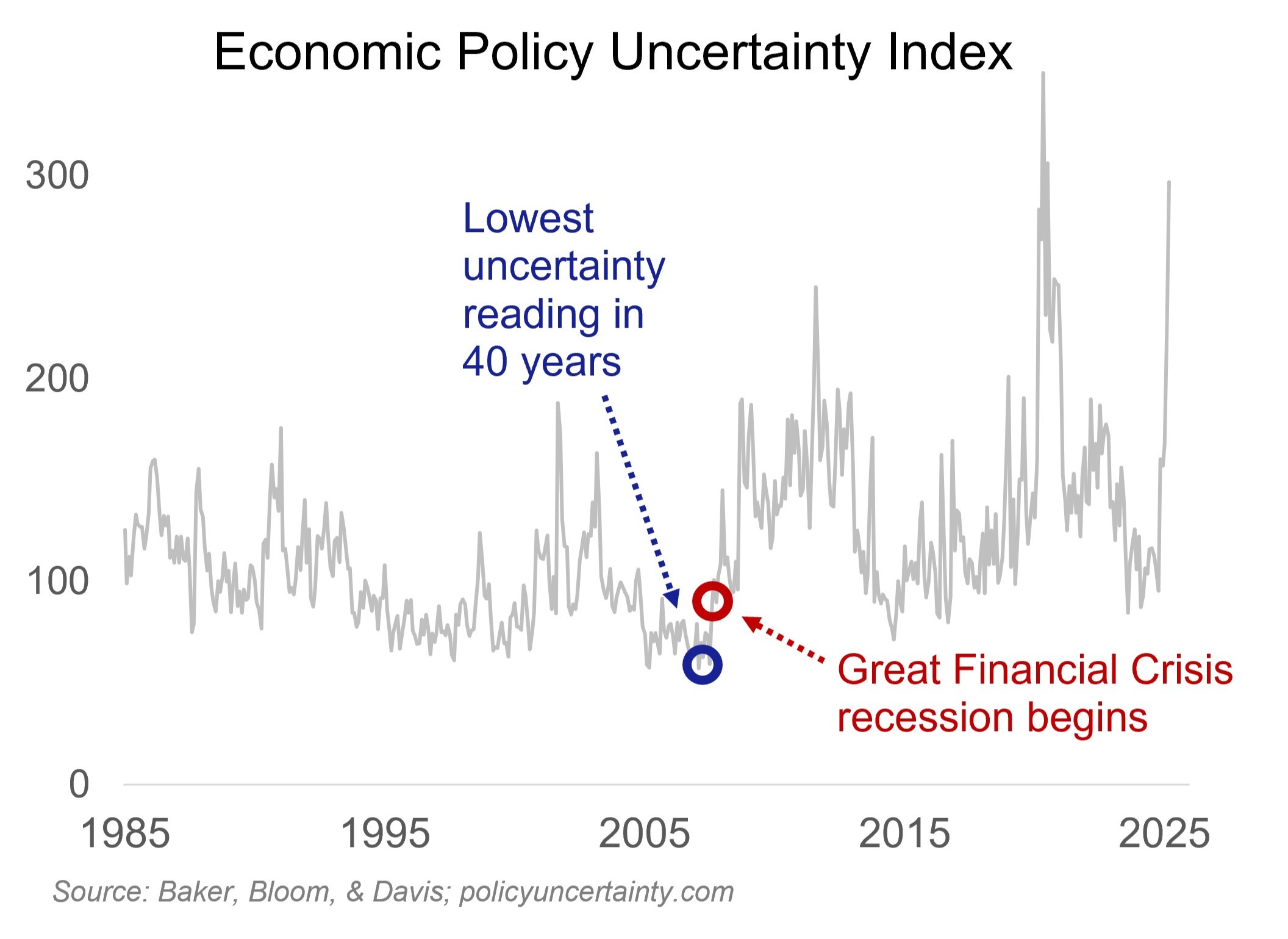
If you’ve followed news lately, you’ve likely seen some version of the “economic policy uncertainty index” to the right. It does a good job of identifying big spikes in uncertainty. But I think there’s another lesson to be learned from this data by looking at the troughs rather than the spikes. When was the “least uncertain” time in the last 40 years? Ah, 2007. This irony of the “least uncertain” time being the eve of the Great Financial Crisis reveals an uncomfortable truth: the world is always an uncertain place, and it’s only our complacency to uncertainty’s presence that ebbs and flows over time. The flip side, of course, is that if the future were perfectly predictable, we couldn’t ever expect outsized returns from equities. Volatility is painful, but when uncertainty reigns, it's often your reaction to it that can determine how well you weather the storm.
Disclosures
This is not a complete analysis of every material fact regarding any company, industry or security. The opinions expressed here reflect our judgment at this date and are subject to change. The information has been obtained from sources we consider to be reliable, but we cannot guarantee the accuracy. Market and economic statistics, unless otherwise cited, are from data provider FactSet.
This report does not provide recipients with information or advice that is sufficient on which to base an investment decision. This report does not take into account the specific investment objectives, financial situation, or need of any particular client and may not be suitable for all types of investors. Recipients should not consider the contents of this report as a single factor in making an investment decision. Additional fundamental and other analyses would be required to make an investment decision about any individual security identified in this report.
For investment advice specific to your situation, or for additional information, please contact your Baird Financial Advisor and/or your tax or legal advisor.
Past performance is not indicative of future results and diversification does not ensure a profit or protect against loss. All investments carry some level of risk, including loss of principal. An investment cannot be made directly in an index.
Copyright 2025 Robert W. Baird & Co. Incorporated.
Other Disclosures
UK disclosure requirements for the purpose of distributing this research into the UK and other countries for which Robert W. Baird Limited holds an ISD passport.
This report is for distribution into the United Kingdom only to persons who fall within Article 19 or Article 49(2) of the Financial Services and Markets Act 2000 (financial promotion) order 2001 being persons who are investment professionals and may not be distributed to private clients. Issued in the United Kingdom by Robert W. Baird Limited, which has an office at Finsbury Circus House, 15 Finsbury Circus, London EC2M 7EB, and is a company authorized and regulated by the Financial Conduct Authority. For the purposes of the Financial Conduct Authority requirements, this investment research report is classified as objective.
Robert W. Baird Limited ("RWBL") is exempt from the requirement to hold an Australian financial services license. RWBL is regulated by the Financial Conduct Authority ("FCA") under UK laws and those laws may differ from Australian laws. This document has been prepared in accordance with FCA requirements and not Australian laws.


