


Thirty years is long enough to see what lasts and what doesn’t. Long enough to weather market cycles, industry shifts, and the changing expectations clients bring to the table. For Preservation Financial, reaching this milestone isn’t about celebration and reflection.
This series exists because the firm’s story doesn’t start with a business plan. It started with a person: Tim Philpot. And understanding the work he’s built means understanding the life that shaped him.
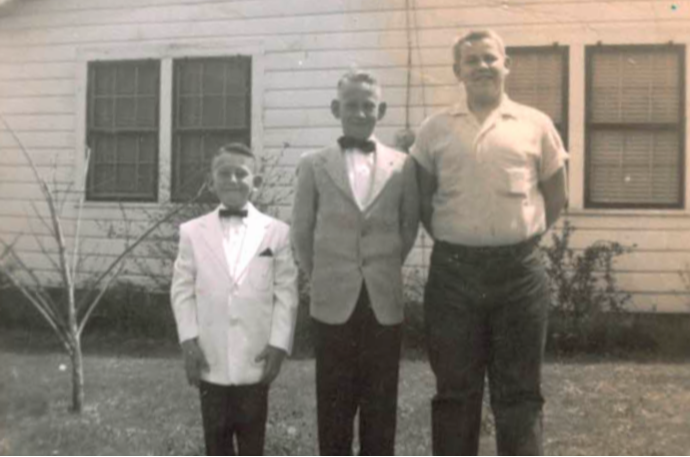
From left to right: Tim Philpot (8), Bobby Philpot (12) and Jack Philpot (16)of their house on Easter Sunday circa April, 1955
Tim was born in Carrollton, Georgia, the youngest of three boys, all four years apart. His father had a fourth-grade education and no patience for the idea that school mattered much beyond it. He was also an alcoholic, and the home Tim grew up in was not a stable one. Looking back now, Tim doesn’t frame those years as something that hardened him. Instead, they clarified what stability really means.
“When things feel unpredictable,” he reflects, “what people need most is steadiness. Someone who shows up the same way every time.”
When Tim was ten, his mother divorced his father. A year later, she remarried. Tim’s stepfather, “Papa” as Tim calls him, was a Navy chief petty officer with 21 years of service, much of it spent on recruiting duty. He talked often about the military, and especially about the difference between officers and enlisted men. To Papa, the distinction was clear: officers had education, and education opened doors.
“It wasn’t presented as a choice,” Tim recalls. “The expectation was that I’d go into the military, and if I was going to do that, I needed to be an officer. That meant college.”
So Papa coached Tim through high school course selection with an eye toward college entrance exams. One recommendation was typing. Tim resisted. “I told him I wasn’t going to be a stenographer,” he says, laughing now. But Papa insisted. Administrative work required it. Decades later, when computers became essential to daily work, Tim understood. The skill he resented learning became foundational.
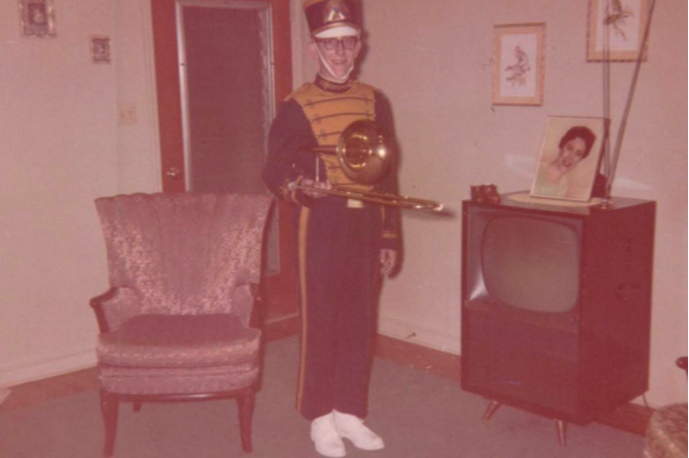
Tim is in his living room in 11th grade, wearing his marching band uniform and holding his trombone.
Tim held three jobs during high school. One was delivering prescription drugs for a local pharmacy. Another was moving houses, where he spent long hours crawling under structures to place hydraulic jacks and blocks. “It taught me that any honest work is okay,” he says. “If that’s what you have to do, you do it.”
But the most formative job was at McDonald’s. He worked every position: cutting and frying potatoes, running the register, manning the grill, and making milkshakes. The pay didn’t change across roles, but the lesson did.
“It was about versatility,” Tim explains. “About showing up and doing what your employer asked you to do, regardless of the task.”
 Tim's High School senior year portrait
When the acceptance letter from the University of Georgia arrived, Tim describes the moment as transformative. He was the only person in his extended family on track to earn a college degree. He had no idea what he wanted to major in, but he knew he was going.
“I didn’t grow up around people who went to college,” Tim says. “There were moments when it felt like everyone else understood the rules already and I was catching up.”
The university was 135 miles away, far enough in those days to feel like real distance. Freshman year in college brought new challenges like a chaotic dorm room where his hall-monitor roommate hosted a constant stream of visitors, making it nearly impossible to study. Tim adapted by spending time in the library, learning to carve out focus where he could.
His first-year grades were solid but unremarkable, a 78 average. Sophomore year, living off-campus with five roommates, wasn’t much better. Different exam schedules meant someone was always partying when someone else needed quiet.
By junior year, Tim found steadier ground. He moved in with one roommate and finally had the space to focus. But he still had no major. No clear direction.
So he went to the campus guidance center and took a ton of aptitude tests. When the results came back, the counselor looked at him and said, “Almost every one of these suggests you’d be a good CPA.”
Tim’s response: “What’s a CPA?”
The counselor explained accounting and suggested Tim take one course to see if it resonated. If it didn’t, he’d only lose a quarter, and he agreed.
The class was taught partly by television, a pilot program in 1967 that combined recorded lectures with in-person discussion led by a graduate student. Tim excelled immediately. He earned near-perfect scores on every exam, not because he was naturally gifted, but because he was disciplined.
“I was never the sharpest knife in the drawer,” he says, “but I wasn’t the dullest. And I could sharpen myself through study.”
He doubled up on courses for most of his remaining quarters, taking four instead of the standard three. Two were always accounting. By graduation in 1969, he had graduated with honors and was second in his class in accounting.
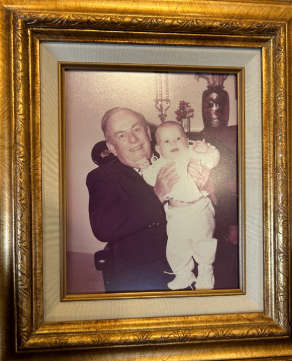
Papa and Tim’s 5-month-old daughter Tiffany, circa 1982
He had found what he was good at, but before his career started, Tim was learning to answer a big question. What does it mean to be prepared when others are depending on you?
Next in the series: How Tim’s path led him into public accounting, through personal loss, and eventually to Texas, where the foundation for Preservation Financial would begin to take shape.