


Retirement is not a sudden, single destination. It is a significant life transition that unfolds over many years—and the way you manage your investments should evolve along with it.
For decades, most investors are conditioned to focus primarily on accumulation: save consistently, invest for growth and build the nest egg as large as possible. But as retirement approaches, the rules of the game begin to change.
The skills required to climb the mountain are not necessarily the same skills required to descend it safely.
During your working years, your investment portfolio generally has one primary job: grow. Your paycheck covers your living expenses, you are regularly adding money to your investments, and you have time to recover from periods of market volatility.
In retirement, your portfolio suddenly has several jobs. It may need to:
- Provide income
- Continue growing enough to keep pace with or exceed inflation
- Manage downside risk
- Remain sufficiently liquid to fund unexpected expenses
It must do all of this while also potentially supporting you for 20 or 30 years and doing so in a reasonably tax-efficient manner.
That transition from accumulation to distribution is one reason investors approaching retirement may benefit from working with investment managers who understand the unique challenges of this stage of life.
The Objective Changes When the Paycheck Stops
When retirement is decades away, market volatility can be uncomfortable, but time is generally on your side. If the stock market declines significantly at age 45, you may have another 20 years of contributions and market growth before you need the money.
That changes when retirement approaches.
Once your paycheck stops, some of the money that previously came from employment may need to come from your investment portfolio instead.
Your portfolio is no longer simply accumulating assets for some distant future. It is helping fund your life today.
That means investment decisions increasingly need to account for questions that may have mattered much less during your working years:
- How much income will you need from your portfolio?
- Where will that income come from?
- How much should remain readily available for near-term expenses?
- How much should continue to be invested for long-term growth?
- And what happens to that plan when markets decline?
These are no longer simply investment questions. They are retirement planning questions as well.
Market Declines Matter Differently in Retirement
One of the biggest changes involves something known as sequence-of-returns risk.
Consider two investors who retire with similar portfolios and ultimately experience similar average investment returns over their retirement. One experiences strong markets during the first several years of retirement. The other encounters a major market decline just as retirement begins.
Their outcomes can be very different.
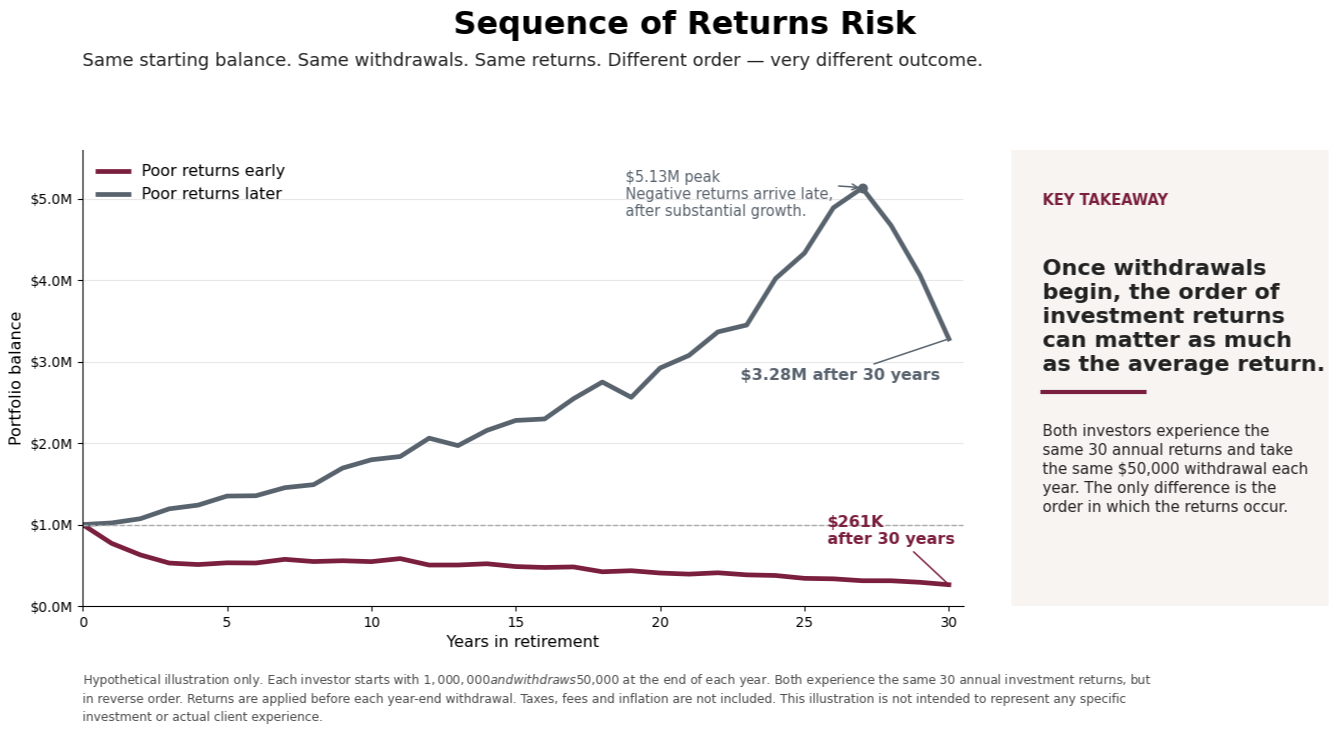
The second investor may need to withdraw money from a declining portfolio to pay living expenses. Selling investments after they have fallen in value leaves fewer assets available to participate as markets recover. If the combination of losses and withdrawals is significant enough, it can have a lasting effect on the portfolio.
This is why volatility takes on a different meaning once withdrawals begin.
During your working years, a market decline may even present an opportunity—you continue contributing to your retirement accounts and purchase investments at lower prices. In retirement, the opposite can occur: instead of buying during a downturn, you may be forced to sell.
Managing that risk does not mean trying to avoid every market decline. That isn't realistic. Instead, retirement portfolios should be constructed with an understanding of where near-term spending will come from and how the investor can avoid unnecessarily selling long-term investments during periods of significant market stress.
Your Portfolio Now Has to Help Create a Paycheck
Most people spend 30 or 40 years receiving a paycheck every two weeks. Retirement can abruptly change that familiar system.
Social Security and pensions may replace part of that income, but many retirees need their investments to make up the difference.
Creating that retirement paycheck requires more than simply selecting investments with the highest yield. It requires coordinating income and withdrawals with the investor's overall financial plan.
How much cash should be maintained? Which investments should fund distributions? How much income should come from interest and dividends versus the sale of investments? How should unexpected expenses be handled? And how should the strategy change during difficult markets?
A well-designed retirement portfolio should consider these questions before the money is needed—not after a market decline occurs.
Taxes Become Part of the Investment Decision
Retirement can also make taxes increasingly intertwined with investment management.
Many retirees enter retirement with several different types of assets: traditional IRAs and 401(k)s, Roth accounts, taxable investment accounts, bank savings and perhaps pensions or other sources of income. Eventually, required minimum distributions may enter the picture as well.
These different sources of retirement income are not necessarily taxed the same way.
As a result, the investment decision is no longer simply what should I own? It can also become where should I own it, and where should my next dollar of retirement income come from?
Investment management and tax planning therefore become increasingly connected as retirement approaches. Decisions about which accounts to draw from, which assets to sell and where different investments are held can potentially affect both the portfolio and the retiree's overall tax picture.
Retirement Doesn't Mean Giving Up on Growth
One of the most common misconceptions about retirement investing is that reaching retirement means becoming a conservative investor.
Certainly, preserving the wealth you have spent decades accumulating becomes increasingly important. But avoiding risk altogether can create risks of its own.
A healthy 65-year-old retiree may need his or her portfolio to provide income for another 25 or 30 years—or longer. Over that period, inflation can substantially increase the cost of maintaining the same lifestyle.
That means retirees generally still need growth. In fact, retirees who have substantial income from sources outside their investment portfolio—such as pensions, annuities or rental properties—to supplement Social Security may have greater flexibility to invest for long-term growth.
If much of their ongoing spending is covered by these other income sources, they may be less dependent on portfolio withdrawals during market downturns and may be able to tolerate a more growth-oriented investment strategy, assuming it is consistent with their risk tolerance and overall financial plan.
The objective isn't simply to preserve the dollar value of the portfolio. It is to balance the need for current income and stability with the need for enough long-term growth to maintain purchasing power throughout retirement.
For many investors, the appropriate question therefore isn't, "How can I eliminate investment risk?"
It is, "Which risks do I need to take to accomplish my goals, and which risks could jeopardize my retirement if they aren't properly managed?"
Risk Means More Than Market Volatility
That distinction becomes increasingly important in retirement because investment risk is no longer limited to whether the stock market rises or falls.
Retirees face several competing risks.
There is market risk—the possibility that investments decline in value.
There is longevity risk—the possibility that you live much longer than expected and need your assets to support you for decades.
There is inflation risk—the possibility that rising prices gradually reduce what your income and savings can purchase.
There is withdrawal risk—the possibility that taking too much from the portfolio, particularly during unfavorable markets, makes future income more difficult to sustain.
And there can even be conservative-investing risk. A portfolio that takes too little investment risk may feel safer in the short term but may not generate enough growth to keep pace with inflation over a long retirement.
Successful retirement investing therefore isn't simply about minimizing volatility. It is about balancing these different risks based on the retiree's individual circumstances.
A Retirement Portfolio Should Be Part of a Retirement Plan
This is where investment management for retirees becomes fundamentally different from simply managing a portfolio.
At Compass Financial Group, we do not believe investments should be viewed as an isolated bucket of money. They are the engine that helps fund your life.
That means investment decisions should be connected to your retirement plan. How much you need from the portfolio, when you will need it, which accounts those withdrawals will come from, how much flexibility you have during difficult markets and how long your assets may need to last should all influence how your portfolio is constructed.
It also means investment strategy should continue to evolve.
The portfolio that was appropriate ten years before retirement may not be appropriate when retirement begins. And the portfolio you need at age 65 may eventually need to change again at 75 or 85 as your spending, income, health, estate-planning priorities and financial circumstances evolve.
For investors searching for Raleigh investment managers, we believe this distinction is important. Investment management for retirees should not simply be about selecting investments or attempting to outperform a benchmark. It should be about designing and managing a portfolio around the life those investments are intended to support.
The Bottom Line
Building wealth and turning that wealth into a sustainable retirement are related—but they are not the same challenge.
The investment strategy that helped you reach retirement may not be the strategy best suited to carry you through it. As retirement approaches, the question should no longer be simply, "How do I maximize my returns?"
It becomes, "How do I make everything I've accumulated work together to support the life I want for the next 20 or 30 years?"
The transition from accumulation to retirement is one of the most important financial transitions you will make. Working with Raleigh investment managers who specialize in retirement planning and investment management can help ensure that your investment strategy evolves as your needs change.
If you are approaching retirement and aren't sure whether your current investment strategy is designed for the transition from accumulating wealth to living from it, we invite you to schedule a retirement assessment with the Compass Financial Group team.
*The opinions voiced in this material are for general information only and are not intended to provide specific advice or recommendations for any individual. Investing involves risk including loss of principal. No strategy assures success or protects against loss.