

The Weekly Wealth Watch
November 16, 2026
The Markets
“Most people overestimate what they can do in one year and underestimate what they can do in ten years.” — Bill Gates, Microsoft Co-Founder.
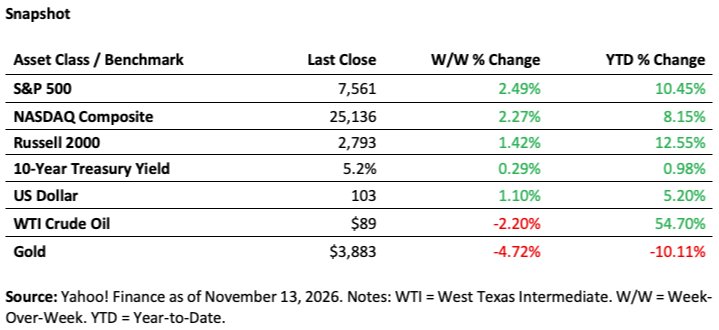
U.S. equities moved higher for the week. The S&P 500 gained 2.49%, finishing at 7,561, while the NASDAQ Composite gained 2.27% to 25,136. The Russell 2000 gained 1.42% to 2,793. Year-to-date, the three benchmarks remain positive, with gains of 10.45%, 8.15%, and 12.55%, respectively.
The 10-Year Treasury yield increased 0.29%, finishing the week at 5.2%. The U.S. Dollar gained 1.10% to 103, bringing its year-to-date gain to 5.20%.
Commodities moved lower. WTI crude oil declined 2.20%, finishing at $89 per barrel, while remaining up 54.70% year-to-date. Gold declined 4.72%, finishing at $3,883, bringing its year-to-date return to a decline of 10.11%.
Overall, markets posted a strong week for equities, with all three major stock benchmarks advancing. Treasury yields and the dollar moved higher, while both oil and gold declined.
Bill Gates’ long-term perspective offers a fitting reminder for investors: short-term market movements can be noisy, while the effects of innovation and long-term trends can take years to fully unfold.
When the Market Prices in Armageddon, Even a Little Good News Can Go a Long Way
Semiconductor stocks have been taken to the woodshed.
Following the surprising election outcome and a sharp industry selloff, investors appear to be pricing in an outright catastrophe. Yet semiconductor billings remain elevated, creating the largest divergence between share prices and industry fundamentals in recorded history.
That's an important distinction: Stocks are forward-looking, while billings reflect shipments and orders already fulfilled. In other words, investors may be selling tomorrow's business based on yesterday's fears.
According to the World Semiconductor Trade Statistics (WSTS), semiconductor billings in the Americas surged 202% year over year in August. That's hardly evidence of an industry that's already fallen off a cliff.
But expectations have changed dramatically. Investors are worried about slowing artificial intelligence (AI) demand, customer inventory digestion and a potential pullback in hyperscaler capital spending.
As Warren Buffett famously observed, “The stock market is a device for transferring money from the impatient to the patient.”¹ Of course, patience is easier when your semiconductor holdings aren't having a yard sale.
The Bottom Line: Opportunity Comes With a Warning Label
The historical evidence suggests that extreme semiconductor stock price declines relative to billings have created attractive forward return opportunities.
- 36.0%: Average 12-month forward return when the semiconductor stock-to-billings ratio fell below its lower statistical band, which is where we are now.
- 16.8%: Average return across the full historical sample.
- 7.5%: Average forward return when the ratio rose above its upper band.
The lower-band return was more than double the historical average, while the upper-band return was less than half.
The current drawdown—-29.9% since June 2, 2026—has already reflected a substantial amount of bad news. That doesn't eliminate downside risk, but it may leave less room for additional disappointment.
The opportunity isn't that everything suddenly becomes wonderful. It's that conditions may only need to become less terrible.
This is a tactical, high-volatility opportunity—not a signal to back up the truck indiscriminately. Selectivity, position sizing and risk management remain essential.
As legendary investor Peter Lynch cautioned, “Far more money has been lost by investors preparing for corrections, or trying to anticipate corrections, than has been lost in corrections themselves.”²
Human Interest: The Semiconductor Clearance Sale
Imagine walking into your favorite electronics store and seeing a television marked down 30%.
You might wonder whether the television is defective—or whether the store simply needs to clear inventory.
That's essentially the semiconductor debate.
Investors have marked down chip stocks dramatically, even as industry billings remain strong. The disconnect could represent a bargain—or a warning that business conditions are about to deteriorate.
The trick is figuring out which.
And as Benjamin Franklin famously advised, “An investment in knowledge pays the best interest.”³ In this case, understanding the difference between stock prices and actual shipments could be worth considerably more than chasing the latest market headline.
Fun Facts & Figures: Chips, Ships and Statistical Extremes
A few numbers that deserve a second look:
- 202%: Year-over-year growth in semiconductor billings in the Americas in August.
- 3–6 months: Typical semiconductor manufacturing lead times between customer orders and recorded billings.
- 3–4 quarters: Lead times can stretch this long during extreme supply shortages.
- -1 standard error: The statistical threshold currently associated with an unusually depressed semiconductor stock-to-billings ratio.
- 36.0%: Average 12-month forward return following historical lower-band readings.
- 7.5%: Average 12-month forward return following upper-band readings.
- -29.9%: Semiconductor stock-price decline since June 2, 2026.
As physicist Richard Feynman warned, “The first principle is that you must not fool yourself—and you are the easiest person to fool.”⁴ A useful reminder that historical averages are evidence, not guarantees.
On This Day in History — November 16
1907: Oklahoma became the 46th state. The country was growing, one state at a time.⁵
1914: The 12 Federal Reserve Banks officially opened for business. A fitting anniversary for a commentary about financial markets—and a reminder that the Fed has been in the business of influencing economic conditions for more than a century.⁶
1945: UNESCO was founded to promote international cooperation through education, science and culture.⁷
2001: The first Harry Potter movie opened in U.S. theaters. Apparently, even the box office was ready for a little magic.⁵
A fitting thought from J.K. Rowling: “It is our choices ... that show what we truly are, far more than our abilities.”⁸ In investing, choices about risk, discipline and timing can matter just as much as identifying a promising opportunity.
Sources & Footnotes:
- Warren Buffett: 1998 University of Florida speech; quotation on patience and market behavior. BuffettKnowledge
- Peter Lynch: Quotation on the risks of trying to anticipate market corrections. selectedfunds.com
- Benjamin Franklin: Commonly attributed quotation on the value of knowledge and investment.
- Richard Feynman: 1974 Caltech commencement address, Cargo Cult Science.
- HISTORY: November 16 historical events, including Oklahoma statehood and the U.S. release of the first Harry Potter film. History
- Federal Reserve history: The 12 Federal Reserve Banks opened on November 16, 1914. AOL.com
- UNESCO: Founded November 16, 1945. Time and Date
- J.K. Rowling, Harry Potter and the Chamber of Secrets: Quotation on the importance of choices.
- World Semiconductor Trade Statistics (WSTS): Semiconductor billings data, including August 2026 growth in the Americas, as provided in the WCG source material.
- YCharts and WCG: Semiconductor stock-to-billings ratio, historical regression bands, event-study results and market performance data, 11/6/26.
Historical forward returns are averages, not forecasts or guarantees. The semiconductor sector remains highly cyclical and volatile.
Disclosures:
- Securities offered through LPL Financial, Member FINRA/SIPC. Investment Advice offered through WCG Wealth Advisors, LLC, a Registered Investment Advisor. WCG Wealth Advisors, LLC is a separate entity from LPL Financial.
- Bond yields are subject to change. Certain call or special redemption features may exist which could impact yield. (118-LPL)
- The S&P 500 is a stock market index tracking the stock performance of 500 of the largest companies listed on stock exchanges in the United States. Indexes are unmanaged and cannot be invested in directly. (102-LPL)
- The NASDAQ Composite Index measures all NASDAQ domestic and non-U.S. based common stocks listed on The NASDAQ Stock Market. The market value, the last sale price multiplied by total shares outstanding, is calculated throughout the trading day, and is related to the total value of the Index. Indexes are unmanaged and cannot be invested in directly. (112-LPL)
- The fast price swings in commodities will result in significant volatility in an investor’s holdings. Commodities include increased risks, such as political, economic, and currency instability, and may not be suitable for all investors. (122-LPL)
- There is no guarantee that a diversified portfolio will enhance overall returns or outperform a non-diversified portfolio. Diversification does not protect against market risk. (26-LPL)
The Russell 2000 Index is generally representative of the 2,000 smallest companies by market capitalization in the Russell 3000 index, which represents approximately 10% of the total market capitalization of the Russell 3000 Index. Indexes are unmanaged and cannot be invested in directly. Bonds are subject to market and interest rate risk if sold prior to maturity. Bond values will decline as interest rates rise. Bonds are subject to availability, change in price, call features and credit risk. The fast price swings in commodities will result in significant volatility in an investor’s holdings. Commodities include increased risks, such as political, economic, and currency instability, and may not be suitable for all investors.
Securities offered through LPL Financial, Member FINRA/SIPC. Investment Advice offered through WCG Wealth Advisors, LLC, a Registered Investment Advisor. WCG Wealth Advisors, LLC is a separate entity from LPL Financial.
1209462-111626