


After nearly four decades in financial planning, I have watched a lot of people focus on one big objective: retirement.
Save enough. Reach the date. Leave the office. Close the door.
But retirement is not really a finish line. The more important question is what happens the morning after you cross it.
That was one of the strongest lessons from my conversation with Jet Vertz, a Navy veteran, former aerospace executive, author, and educator whose life has been shaped by perseverance and reinvention. Jet came to the United States from Korea as a young boy with limited English and eventually rose to become a Vice President at Pratt & Whitney Aircraft. His story is one of determination, but what interested me most was what happened after the career success.
He retired. He had freedom. He had time. And after several months, he realized something important was missing: purpose.
That realization eventually led him to teach a course called Purpose-Driven Retirement at the University of Rhode Island. His experience offers a valuable reminder for anyone approaching retirement: financial readiness matters, but emotional readiness and a reason to get up in the morning matter too.
Quick Answers
What is purpose-driven retirement? Purpose-driven retirement means intentionally building life after full-time work around meaningful personal goals, family relationships, and contribution rather than treating retirement only as the absence of a job.
Why can retirement feel empty even when someone is financially prepared? Work often provides structure, identity, relationships, challenge, and a sense of contribution. Leaving those behind without replacing them can create an emotional gap even when the financial plan is sound.
What are the three areas of purpose Jet Vertz recommends? Jet encourages retirees to pursue something for themselves, something for their family, and something for their community or the wider world.
How does financial planning support a meaningful retirement? Financial planning can help clarify whether income, savings, protection, and other resources are aligned with the activities and lifestyle someone wants to pursue after work.
Is retirement the end of productive life? No. Retirement can become a new beginning in which experience, time, skills, and financial resources are redirected toward goals that may have been difficult to pursue during a full-time career.
Purpose-Driven Retirement Begins With a Better Question
Most retirement planning starts with a number: How much money will I need?
It is an important question. It is not the first question.
The better place to begin is: What do I want this next chapter to be for?
Jet experienced that distinction firsthand. After leaving decades of work in aerospace, he moved to Rhode Island and initially enjoyed the things many people imagine when they picture retirement: walks on the beach, rounds of golf, no deadlines, and freedom from the schedule that had shaped his working life.
For about six months, that freedom felt good. Then something changed.
He still had energy. He still had a sharp mind. He still had experience to share. Without a meaningful outlet for those things, retirement began to feel less like freedom and more like unused capacity.
That is why I like the idea behind our FiduciWho Short Retirement Isn't the Finish Line, It's the Starting Line. The financial plan should help you reach retirement, but the life plan tells you what to do once you get there.
This also connects naturally with Fritz Gilbert’s perspective on intentionally designing life after work. Retirement becomes much more useful when it is treated as a chapter to build rather than a career simply ending.
The Three-Part Framework for Finding Purpose in Retirement
Jet’s framework for purpose-driven retirement is simple enough to remember and broad enough to make personal.
1. Do Something for Yourself
Retirement should contain something that belongs to you.
It may be learning, travel, physical activity, writing, teaching, creating, rebuilding an old hobby, developing a new skill, or pursuing a project that never fit comfortably around a career.
The point is not constant entertainment. It is continuing to grow.
2. Do Something for Your Family
A successful career can consume enormous amounts of time and attention. Retirement may create a chance to strengthen relationships that did not always receive the time you wished you could give them.
That could mean being more present with a spouse, children, grandchildren, siblings, or other people who matter to you. It can also mean sharing stories, experience, values, and family history.
3. Do Something for Your Community or the World
Jet found this part through education. Instead of treating his knowledge as something that ended with his corporate career, he redirected it toward helping other people think about their own retirement and purpose.
Your version may look entirely different. Mentoring, volunteering, serving on a board, supporting a cause, coaching younger professionals, helping a local organization, or contributing to a community can create a sense that your accumulated experience still matters.
The FiduciWho Short Purpose Has Balance fits this framework well. A meaningful life does not have to be built around one giant mission. Purpose can come from balancing what matters to you, the people you love, and the contribution you want to make.
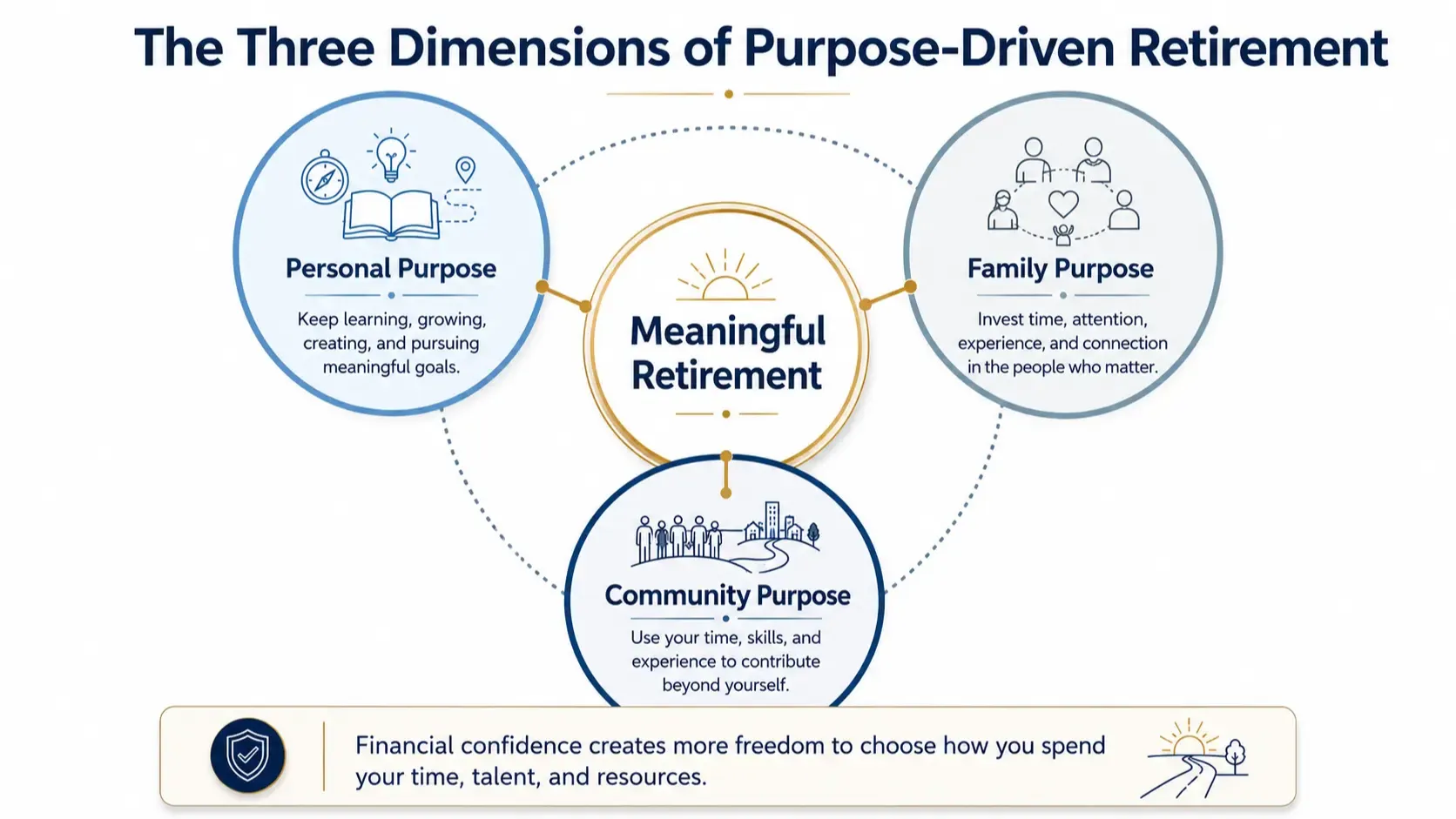
Financial Confidence Gives Purpose More Room to Grow
Purpose without planning can become frustrating. Planning without purpose can become empty.
Jet made the connection clearly: before someone can freely pursue the retirement they imagine, they need enough financial stability to reduce the constant pressure of worrying about money.
That does not mean a person needs unlimited wealth before living meaningfully. It means the financial plan should be connected to the life plan.
If you want to travel, what does that lifestyle cost? If you want to volunteer extensively, how does that affect income needs? If you want to help family, what level of support fits without undermining your own security? If you want to teach, consult, or work part-time, how might that income affect the plan?
Those are better planning conversations than starting with a generic retirement number.
At Raskin Global, I think about this through Protect, Grow, Enjoy, and Transfer.
Protect the foundation so one major disruption does not undo the plan. Grow resources with the future in mind. Enjoy what you have built while you are here. And Transfer wealth, wisdom, and opportunity according to what matters to you.
Our Short on being financially and emotionally ready to retire captures why both sides matter. A strong account balance does not automatically answer questions about identity, relationships, routine, or purpose.
For a related perspective, Brian Herriot’s discussion of why time freedom can matter more than financial freedom reinforces the idea that wealth becomes most useful when it creates choices about how you spend your life.
Perseverance Still Matters After the Career Ends
When I asked Jet about the foundations of his life, he gave me three principles: study hard, work hard, and persevere.
The third one may be the most important.
Jet’s life included leaving Korea as a young boy, adjusting to America, building a demanding career, serving in the Navy, and eventually reinventing himself after retirement. The circumstances changed, but the need to adapt did not.
Retirement can require its own form of perseverance.
A long career creates routines and identity. People know where they are supposed to be on Monday morning. Colleagues know what they do. Their expertise has a place. Then retirement arrives and much of that structure disappears at once.
Finding the next chapter may take experimentation.
The first hobby may not be enough. A volunteer role may not fit. The move you imagined may feel different once you make it. A spouse may have a completely different vision of retirement. Health or family needs may alter the plan.
That does not mean retirement failed. It means the plan needs to remain dynamic because life remains dynamic.
The American Dream Can Evolve With Your Life
Jet’s memoir, American Dream, reflects a life shaped by hard work, perseverance, faith, and opportunity.
His story does not suggest that success is effortless or that everybody starts from the same place. In our conversation, we acknowledged that circumstances change and younger generations may face challenges different from those faced decades ago.
But the larger principle still matters: dreams require action, adaptation, discipline, and persistence.
The American Dream does not have to be defined by a single job title, house, account balance, or retirement date. It can evolve.
At one stage, the dream may be building a career. At another, supporting a family. Later, it may become having enough independence to choose meaningful work instead of required work. Eventually, it may center on service, mentorship, teaching, or legacy.
Financial planning should be flexible enough to recognize those transitions.
Your goals at 45 may not be your goals at 65. Your definition of success at 70 may be different again. A useful plan should provide a framework for making decisions as those priorities change rather than locking you into an old definition of the future.
Retirement Planning Should Include Time, Talent, and Treasure
We spend a lot of time in financial planning discussing assets. We should spend more time discussing calendars.
A purpose-driven retirement is ultimately about deciding what you want to do with three resources: your time, your talent, and your treasure.
Your time may become more flexible once full-time work ends. Where do you want it to go?
Your talent represents decades of experience, skills, relationships, and knowledge. Does all of that stop being useful simply because a payroll relationship ends?
Your treasure gives you the financial capacity to support the life, family, causes, and legacy that matter to you.
Put those together and retirement planning becomes much more interesting than simply calculating a withdrawal rate.
A few useful questions include:
- What would make an ordinary Tuesday feel meaningful after I stop working full time?
- What part of my identity do I want to keep after my career ends?
- Which relationships deserve more of my time?
- What skills or knowledge could I share with somebody else?
- What causes or communities matter enough for me to become involved?
- Does my financial plan support the lifestyle and contribution I am describing?
- What would I regret not doing if I had the freedom and resources to do it?
Those questions do not replace the financial analysis. They give the analysis a reason to exist.
Final Thoughts
Purpose-driven retirement starts with understanding that retirement is not the goal by itself. The goal is having enough freedom, confidence, and intention to build a life that continues to matter after the career ends.
Jet Vertz’s story gives us a useful framework: keep something for yourself, strengthen something within your family, and contribute something beyond yourself.
Then make sure the financial plan can support the picture you are drawing.
That is where Protect, Grow, Enjoy, and Transfer becomes more than a financial framework. Protect the life you have built. Grow the resources that create options. Enjoy the time and experiences those resources can support. Transfer wealth, values, knowledge, and opportunity with intention.
Your dreams matter, and your future is our priority. If retirement is approaching, consider planning not only for the day you stop working, but for the years that follow. A qualified financial professional can help you evaluate whether your income, assets, risks, and long-term resources align with the retirement you actually want to live.
Frequently Asked Questions
What is purpose-driven retirement?
Purpose-driven retirement means intentionally building life after full-time work around meaningful personal goals, family relationships, and contribution rather than treating retirement only as the absence of a job.
Why do some people lose a sense of purpose after retirement?
A career can provide identity, routine, relationships, challenge, and a sense of contribution. When those elements disappear at once, retirees may need to intentionally create new sources of structure and meaning.
What are the three types of purpose Jet Vertz recommends for retirement?
Jet Vertz recommends having something meaningful for yourself, something for your family, and something that contributes to your community or the wider world.
How does financial planning support a purpose-driven retirement?
Financial planning can help connect income, spending, assets, protection, and long-term resources with the activities, relationships, and contributions someone hopes to pursue after leaving full-time work.
How can I prepare emotionally for retirement?
Consider what will replace the identity, routine, relationships, and sense of accomplishment that work currently provides. Planning activities, personal goals, family time, and meaningful contribution before retirement can help make the transition more intentional.
What questions should I ask before I retire?
Ask what you want an ordinary week to look like, which relationships matter most, how you want to use your skills and experience, what contribution you want to make, and whether your financial resources support that vision.